2
Table of Contents
Introduction ................................................................................................................. 3
Chapter 1. English for Specific Purposes .................................................................. 7
1.1 Definition and Historical Growth of ESP ................................................... 7
1.2 Types and Characteristics of ESP ............................................................. 12
1.3 Strategies and Methods for Teaching ESP ............................................... 20
Chapter II. Case Studies as Linguo- didactic Tool ................................................ 33
2.1 Concept, Definition and Typology of Case Studies ................................. 33
2.2 Case Studies Preparation and Framing Steps ........................................... 37
Chapter III. Organization of ESP Teaching with Case Studies ........................... 41
3.1 The ESP Teacher Classroom Activities and Professional Competences . 41
3.2 Peculiarities of Teaching ESP with Case Studies. Advantages and
Disadvantages of Teaching with Cases .......................................................... 49
3.3 A Model Case Study Framed for Teaching Business English as ESP Type
......................................................................................................................... 59
Conclusion .................................................................................................................. 65
Bibliography .............................................................................................................. 70
Annexes ....................................................................................................................... 74
3
Introduction
The fast-changing global environment and the ever-growing demand facing
professional communicators in the 21st century pose new challenges to language
learners and teachers alike. Competitive organizations attempt to recruit employees
who have excellent linguistic competence coupled with non-linguistic competences
and skills. Acquisition of such skills and abilities is a complex and long-lasting process.
However, most of them are transferable and can be greatly improved if learners are
provided with adequate teaching techniques and appropriate input from the teacher.
Foreign language teachers for Specific Purposes have a lot in common with
teachers of general foreign language. For both it is necessary to consider linguistic
development and teaching theories, to have insights in contemporary ideas regarding
their own position and role as well as the position and role of foreign language learners
in education and to face new technologies offered as an aid to improve their
methodology. The needs to understand the requirements of other professions and
willingness to adapt to these requirements differentiate the foreign language teachers
for specific purposes and their colleagues teaching general foreign language.
English for Specific Purposes teaching presumes teaching of English as a
foreign language regarding specific profession, subject or purpose. Teaching materials
and tools used in English for Specific Purposes courses should reflect the language
used by professionals in typical communication acts. The content of any English for
Specific Purposes course today needs to be judiciously selected both in terms of content
matter, material selection and the way the material is conveyed to the learner, one of
the tools used for these purposes being case studies [23].
Case Studies are an effective teaching tool that can be used to teach various
disciplines, be it science, technology, or language for the simple reason that they
employ a wealth of practical real-life models and paradigms that can be used to
contextualize and articulate theoretical concepts. This is possible because the
examples, activities, and teaching structures used in this methodology are very rich in
content and reinforce the knowledge that has already been gained. In addition to this,
teaching through case studies incorporates a host of social, personal, and true-life

4
pedagogical material which can be utilized for effective language learning.
The significance of this topic is demonstrated by the fact that in the era of rapid
and increasing economic globalization the necessity of teaching English for Specific
Purpose is growing as well, and one of the tools that teachers try to implement are case
studies and effective teaching depends, to a large extent, on understanding how to
effectively draft, use and evaluate the case studies.
The object of the paper is English for Specific Purposes (ESP) as an important
aspect of teaching English as a Foreign Language.
The subject of the paper is the use of Case Studies as a tool of English for
Specific Purposes.
A deep analysis of problems relating to case study design and development in
language teaching will reveal the possible ways of improving the quality of ESP
teaching.
The aim of the paper is to address the complexity of ESP teaching today and
exactly to examine the theoretical and practical issues of teaching ESP using case
studies, with the purpose of exploring the depth of the professional linguistic and
extralinguistic skills that the teacher has to master for providing an efficient teaching
outcome. The following objectives are set to accomplish the aim of this paper:
(1) examine the concept of English for Specific Purposes, its peculiarities,
characteristics, types and differences from teaching general language.
(2) examine the theoretical principles of teaching and learning a foreign
language using case studies;
(3) identify the main criteria and principles used in classification, design and
development of case studies;
(4) identify the main peculiarities and challenges of using case studies in
teaching ESP;
(5) design a model case study for teaching Business English as a form of ESP.
Chapter I of this paper is intended to offer a theoretical overall description of
English for Specific Purposes. It consists of three parts.
5
Subchapter 1.1 will define the concept of ESP. Linguists have defined ESP
differently, adding new aspects to the concept of ESP during its historical development.
This chapter will give a historical overview of how ESP appeared and
developed, why it became a separate branch of English for General Purposes and what
are the differences between English for Specific Purposes and English for General
Purposes.
Subchapter 1.2 will include a comprehensive explanation and analysis of types
and characteristics of ESP. It is important to describe and understand the differences
between the absolute and variable characteristics of ESP. Main ESP characteristics led
to appearance of ESP typology. ESP types will also be described in this chapter.
Subchapter 1.3 will present the range of approaches and tools that are used to
teach ESP, their characteristics, the positive and negative aspects of using one or
another method.
Chapter II will focus on one of the ESP methods, the Task Based Learning
method, and its teaching tool - Case Studies. Chapter II consists of 2 subchapters.
Subchapter 2.1 will include a comprehensive explanation of the Case Study
concept, its definition and typology. This subchapter will also describe the differences
between the two Case Study schools, and their approaches concerning the use of case
studies in teaching ESP.
Subchapter 2.2 is focusing on the theoretical part of drafting a case study. It
will include the characteristics of the drafting process, the rules of this process and the
specific features of what makes a case study to be effective and lucrative.
Chapter III will offer a practical approach to the problem of teaching ESP
using cases and to the overall organizational process of teaching with cases. Chapter
III consists of three subchapters.
Subchapter 3.1 will describe the peculiarities of organizing a case study lesson.
It will also emphasize the advantages and disadvantage of working with cases for both:
teachers and learners.
Subchapter 3.2 offers a view over the teacher's professional skills for working
with case studies when teaching ESP. It will include a description of the abilities and
6
knowledge that the teacher has to master and apply in the process of teaching with
cases, as well as, what are the ways and techniques to acquire such.
Subchapter 3.3 will include a model case study, prepared by myself according
to the rules and requirements of case studies drafting process, aiming to present a real
example of what and how cases should be used in teaching ESP, in this paper the
Business English aspect of ESP has been chosen.
For the purpose of this paper such research and investigation methods are
used: analysis of the theoretical basis, analogies and generalization of thematic
material.
In the practical part of the paper a model case study based on a real business
situation is drafted as an example of how the teachers shall draft a case study following
the rules and steps necessary for this purpose. This part will also give guidelines of
how to work with this case study during teaching a Business English class, as one type
of English for Specific Purposes.
The scientific novelty of this work resides in the fact that it does not only
propose an analysis of the theoretical literature on this topic, but it has tested the whole
process of drafting a Business English case study, aiming to prove whether just
knowledge of language system and ability to deliver is enough for the ESP teacher.
The teaching of English for Specific Purposes has been a separate activity
within English language teaching. ESP, if moved away from the established trends in
general English teaching, has always been with additional needs of analysis and
learners grounding to communicate effectively in the tasks prescribed by their field of
study or work situation [24].
7
Chapter 1. English for Specific Purposes
1.1 Definition and Historical Growth of ESP
English for specific purposes refers to the teaching and learning of English as
a second or foreign language where the goal of the learners is to use English in a domain
[4, p. 63]. The teaching of English for specific purposes, in its early days, was largely
motivated by the need to communicate across languages in areas such as commerce
and technology. This has now expanded to include other areas such as English for
academic purposes, English for occupational purposes, English for vocational
purposes, English for medical purposes, English for business purposes, English for
legal purposes, and English for sociocultural purposes [4, p. 112].
According to Guerrero English for Specific Purposes is a movement in
language teaching that started in the 1960s. The focus of this language teaching is based
on the specific needs and language use of a target group. It takes into account the socio-
cultural contexts in which the learners will be using English, tends to be learner-
centered, and is not confined to a specific methodology [18, p. 5].
Definitions of ESP in the literature are relatively late in time, if we assume that
ESP began in the 1960s. Hutchinson and Waters [22] define ESP as an approach rather
than a product – meaning that ESP does not involve a particular kind of language,
teaching material or methodology. The basic question of ESP is: Why does the learner
need to learn a foreign language? The purpose of learning English became the core.
The term ESP has been in use for a half of a century now, and its definition can be
found in many issues on the subject. Hutchinson and Waters [ibid.] attempt to define
ESP not by showing what ESP is, but rather showing what ESP is not:
a) ESP is not a matter of teaching' specialized varieties' of English. The fact
that language is used for a specific purpose does not imply that it is a special form of
the language, different in kind from other forms. There are some features which can be
identified as typical of a particular context of use and which, therefore, the learner is
more likely to meet in the target situation. However, these differences should not be
allowed to obscure the far larger area of common ground that underlies all English use,
and indeed, all language use.

8
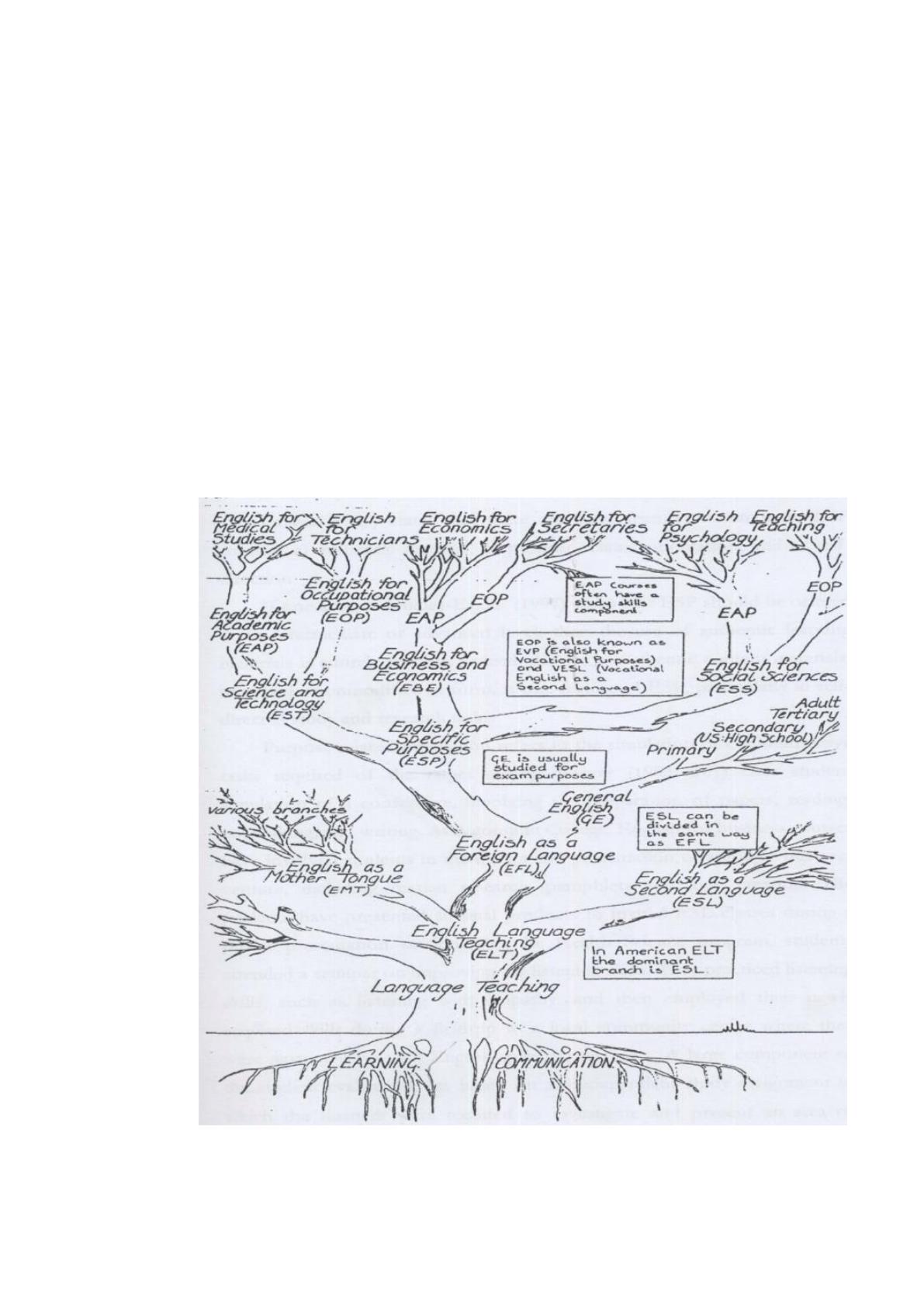
b) ESP is not just a matter of Science words and grammar for Scientists.
Hutchinson and Waters make an analogy of ESP with a tree (Figure 1). When someone
looks at a tree, he sees the leaves and branches, but there is much more to the tree than
just these- much of it hidden from view inside and beneath the tree. The leaves do not
just hang in the air: they are supported by a complex underlying structure. In the same
way there is much more to communication than just the surface features that one read
and hear. It is important to distinguish, between performance and competence, which
is between what people actually do with the language and the range of knowledge and
abilities which enables them to do it.
Figure 1.
ELT Tree [22, p. 17]
ESP is not different in kind from any other form of language teaching, in that
it should be based in the first instance on principles of effective and efficient learning.
9
There is no such thing as an ESP methodology, merely methodologies that have been
applied in ESP classrooms, but could just as well have been used in the learning of any
kind of English [22, p. 18].
There is no complete agreement about the historical growth of ESP, though
several research studies have been undertaken by different researchers in this regard.
Most of the studies have concluded that 1960’s was the dawn of this ELT approach,
but several studies mentioned the traces of ESP much before the above-mentioned
period. Hutchinson and Waters traced back an ESP book in the sixteenth century. This
book was written for tourists and it was published in 1576. “German for Science
Students” was another example of ancient ESP material. This early phase of ESP lasted
roughly till the start of 1960 and whatever ESP material was produced during this
period, it mainly consisted of authentic material related to different fields of
specialization [12].
Therefore, most of the linguists declared that the real beginning of ESP set in
about in the sixties of twentieth century. Dudley-Evans and St. John [12, p. 19]
mentioned that "it was undoubtedly in the mid-to late 1960's, however, that various
influences came together to generate the need and enthusiasm for developing ESP as a
discipline".
There is a long-term retrospective view on causes resulting in the birth of ESP,
when they present nearly the same factors, which, in turn, suggest a cause effect
relationship:
▪ the enormous and unprecedented expansion in scientific, technical and
economic activity on an international scale. Two forces were dominating the new post-
war world – technology and commerce, whose relentless progress soon generated a
demand for an international language and, due to the economic power of the U.S. it
was English which was granted this role.
▪ the emerging of a new mass of people wanting to learn English – the key
to international currencies of technology and commerce. This mass of people joined
together particularly new generations of learners who knew specifically what they were
to learn and why.
10
▪ the Oil Crises of the early 1970s involved a massive flow of funds and
western expertise into the oil-rich countries. Therefore, English suddenly turned into
‘big business’ and, on the other hand, commercial pressures began to exert an influence
in the acquisition of this language. Time and money constraints created a need for cost
effective courses with accurately specific goals.
▪ the need for several countries to update their knowledge [12, p. 6].
Hutchinson and Waters [22] also enumerated three main reasons for this rapid
growth. They were the “demands of a Brave New World”, a “revolution in linguistics”
and “focus on the learner”. The rapid expansion in scientific, technical and economic
activities in English speaking countries and the linguistic trends as the main
contributing factors in this regard. English became subject to the wants, needs, and
demands of people other than language teachers. It was the learner who explicitly
called for courses tailored to meet their professional needs.
Dudley-Evans and St. John [12, p. 19]also reported that growth of science,
technology and business played an important role in the development of ESP and "an
enormous number” of students came to the UK, USA and Australia and this factor
initiated "a new era of teaching English for different scientific and business disciplines”
and English was given the status of the "international language of science, technology
and business". The ESP material produced during that period mainly concentrated on
specific grammatical and lexical items instead of real communication.
A significant discovery at that time was that the ways in which one speaks a
language and writes in a language vary. The significance of this discovery was that, as
a result of these variations in language use, language teaching could be tailored to both
spoken and written professional situations. Another significant discovery came from
the psychology of learning – the research showed that another focus shift was needed,
that from language delivery to language acquisition.
Focus on learners’ needs became as important as the methodology of language
teaching. Designing courses that could best meet these needs was bound to be a
success. According to the definition given by Hutchinson and Waters [22, p. 19], “ESP
is an approach to language teaching in which all decisions as to content and method
11
are based on the learner’s reason for learning.” It was a real revolution in language
teaching – from a teacher-centered approach to a learner-centered and learning-
centered approach, a milestone in language teaching that had its repercussions for the
decades to come.
Following its development Hutchinson & Waters show that ESP was
subdivided into English for Science and Technology (EST), English for Business and
Economics (EBE), and English for Social Studies (ESS). Each of these three varieties
was further subdivided into EAP and EOP. Now ESP is an umbrella term which
includes English for Science and Technology, English for Academic Purposes, English
for Business and Economics, English for Management, English for Medicine, English
for Finance and Banking, English for Law, English for
Tourism/Engineering/Accounting, etc. (Figure 1).
The number of ESP dictionaries reflects the creation and development of each
variety of ESP. By analyzing the year of publication, the type and the number of ESP
dictionaries on the market, we can make conclusions on the popularity of each ESP
variety. It demonstrates the popularity and expansion of ESP. Today we can witness
that publishers not only offer course-books and on-line materials for the varieties of
ESP presented above but also publish books and materials targeted at a single
profession, e.g. English for Nurses, English for Job Hunters, English for Beauticians
or Air Speak (English for Air Traffic Controllers). The variety of course-books on offer
shows that there is a huge demand for highly specialized language courses.
At the early stages of ESP teaching, courses were aimed mainly at specialized
linguistic competence. In the 1970s, specialized terminology and functional language
were regarded to be the priorities in ESP courses. Courses were, to a great extent,
language-oriented, and their main aim was to teach specialized lexis and grammar.
In the mid-1970s and 1980s, a new approach to teaching business English
appeared – it was the communicative language teaching approach focused on
communication in typical professional situations. With time the priority of linguistic
competence was replaced by the priority of communicative competence, and
communication skills became target number one in ESP.