12
In Europe, the 1990s were the decade when the following important
innovations were introduced: the euro, financial deregulation, and venture capital.
Throughout the world, globalization processes brought greater job mobility and
international cooperation. It was also the time when new communication technologies
became more accessible worldwide: the Internet and mobile phones have significantly
facilitated and sped up communication. All these changes have had a strong impact on
learners’ needs.
Therefore, ESP came into being and gradually developed into a multilayered
language approach primarily based on learners’ specific needs required by their
professions or occupations. The domain labeled ESP was proven to have a universal
dimension through the concept of language for specific purposes and a language-
specific perspective through the insights explored into various European languages
[11]. ESP did not begin just because of some new theories or ideas in any field. It was
mainly because of the necessity of the time which shaped ESP in the present form.
1.2 Types and Characteristics of ESP
English for Specific Purposes as branch of general English has as main goal the
teaching of English to the learners who have specific goals and purposes Robinson
[35]. These specific purposes are the above-mentioned academic, professional or
scientific ones that clearly depend on the learners’ needs. This definition does not
confine ESP to any specific field, discipline or profession and recognize its broader
area of action.
A rather comprehensive approach to define ESP has been tried by identifying
its absolute and variable characteristics. Strevens' definition makes a distinction
between four absolute and two variable characteristics [39, p. 13]:
I. Absolute Characteristics:
ESP consists of English language teaching which is:
• designed to meet specified needs of the learner;
• related in content (i.e. in its themes and topics) to particular disciplines,
occupations and activities;
13
• centered on the language appropriate to those activities in syntax, lexis,
discourse, semantics, etc., and analysis of this discourse;
• in contrast with General English.
II. Variable characteristics:
ESP may be, but it is not necessarily:
• restricted as to the language skills to be learned (e.g. reading only);
• taught according to any pre-ordained methodology.
This definition tries to identify ESP in contrast with General English.
Therefore, the emphasis is on “Specific English” that belongs to some particular
discipline, occupation or activity. This definition makes it mandatory that ESP courses
should concentrate on the language, i.e. syntax, lexis, discourse, semantics etc., which
is appropriate for some particular discipline, occupation or activity. Dudley-Evans and
St. John have presented a modified definition of ESP which is also comprised of
absolute and variable characteristics of ESP that are as follows [12, p. 4-5]:
I. Absolute Characteristics
• English for specific purposes is designed to meet specific needs, disciplines
and interests of learners.;
• ESP makes use of the underlying methodology and activities of the discipline
it serves;
• ESP is centered on the language (grammar, lexis, register), skills, discourse
and genres appropriate to these activities.
II. Variable Characteristics
• English for specific purposes is related to and designed for specific
disciplines, especially few ones, and in some situations, it may be focused on only one
discipline;
• ESP may use, in specific teaching situations, a different methodology from
that of general English;
• ESP is likely to be designed for adult learners, either at a tertiary level
institution or in a professional work situation. It could, however, be for learners at
secondary school level;

14
• ESP is generally designed for intermediate or advanced students;
• Most ESP courses assume some basic knowledge of the language system, but
it can be used with beginners.
This definition also acknowledges that ESP is meant to meet learner’s specific
needs, but it has removed the characteristic mentioned in Strevens’ definition that ESP
is in contrast with General English. This modified definition has extended the horizon
of ESP by allowing it to encompass the specific needs of the students who do not
necessarily belong to any specific occupation or discipline.
Dudley-Evans and St. John have also enhanced the list of variable
characteristics as well. They have contended that ESP is not necessarily but “may be
related to or designed for specific disciplines” and different methodologies “from that
of General English” may be employed to cater for the needs of the specific teaching
situations for specific disciplines. Dudley-Evans and St. John have asserted that ESP
courses are “likely to be designed for adult learners” but may be organized “for learners
at secondary school level”. Likewise, they have pointed out that ESP courses may be
planned for the beginners along with intermediate or advanced students [12].
It comes out from the above discussion that the key to teaching ESP is to focus
on the “S” for specific. ESP can be differentiated from general ELT by its concern with
specialized language and practice, but this word “specific” might apply to special
language or special needs / aim [ibid.].
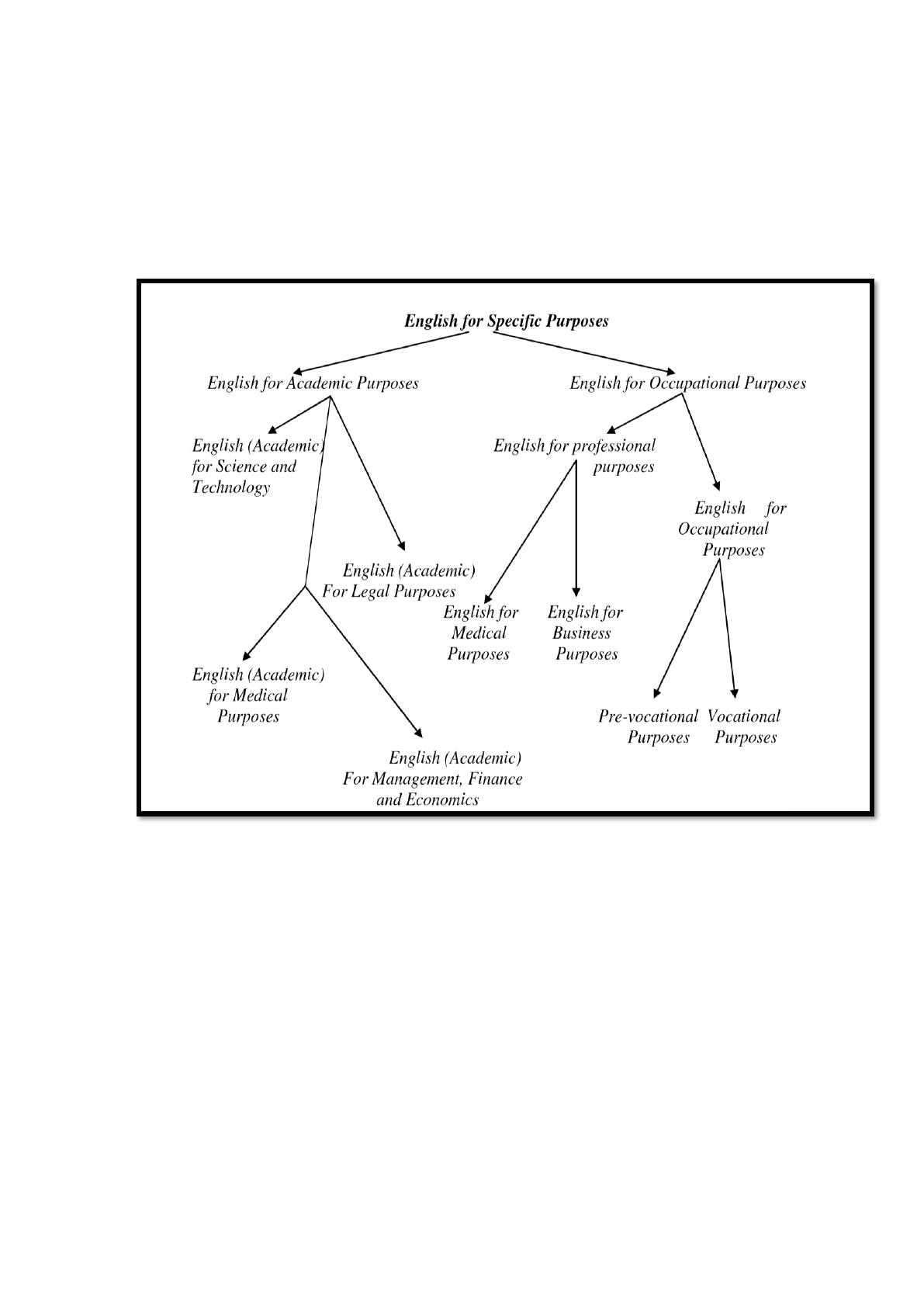
Traditionally ESP is divided into English for Academic Purpose (EAP) and
English for Occupational Purpose (EOP), both of which are sub-divided into further
categories. Dudley-Evans and St. John, have divided EAP into two divisions: English
for General Academic Purposes (EGAP) and ESAP. EGAP is related to the teaching
of language skills that are common in different disciplines but ESAP refers to the
teaching of language features that are specific for various disciplines. Research has
offered insights into the mutual relationship of EGAP and ESAP. Skills and language
functions learnt in EGAP programs may be transferred to specific disciplines in ESAP
programs [ibid.].
15
Many researchers have discussed about the types of ESP and most of them have
grouped ESP into two main categories: English for Occupational Purposes (EOP) and
EAP [14]:
Figure 2.
Types of English for Specific Purposes [7, p. 142]
Hutchinson and Waters underline that EOP and EAP are not entirely separate
phenomena. They have argued that “people can work and study simultaneously; it is
also likely that in many cases the language learnt for immediate use in a study
environment will be used later when the student takes up, or returns to, a job” [ibid., p.
12]. However, there is a difference between these two terms. EAP refers to English
required in an educational institution like school, college and university and it is
concerned with those communication skills in English which are required for study
purpose in formal educational system. Whereas, EOP refers to English required for
professional communication in professional context like medical, engineering, aviation
and business.
16
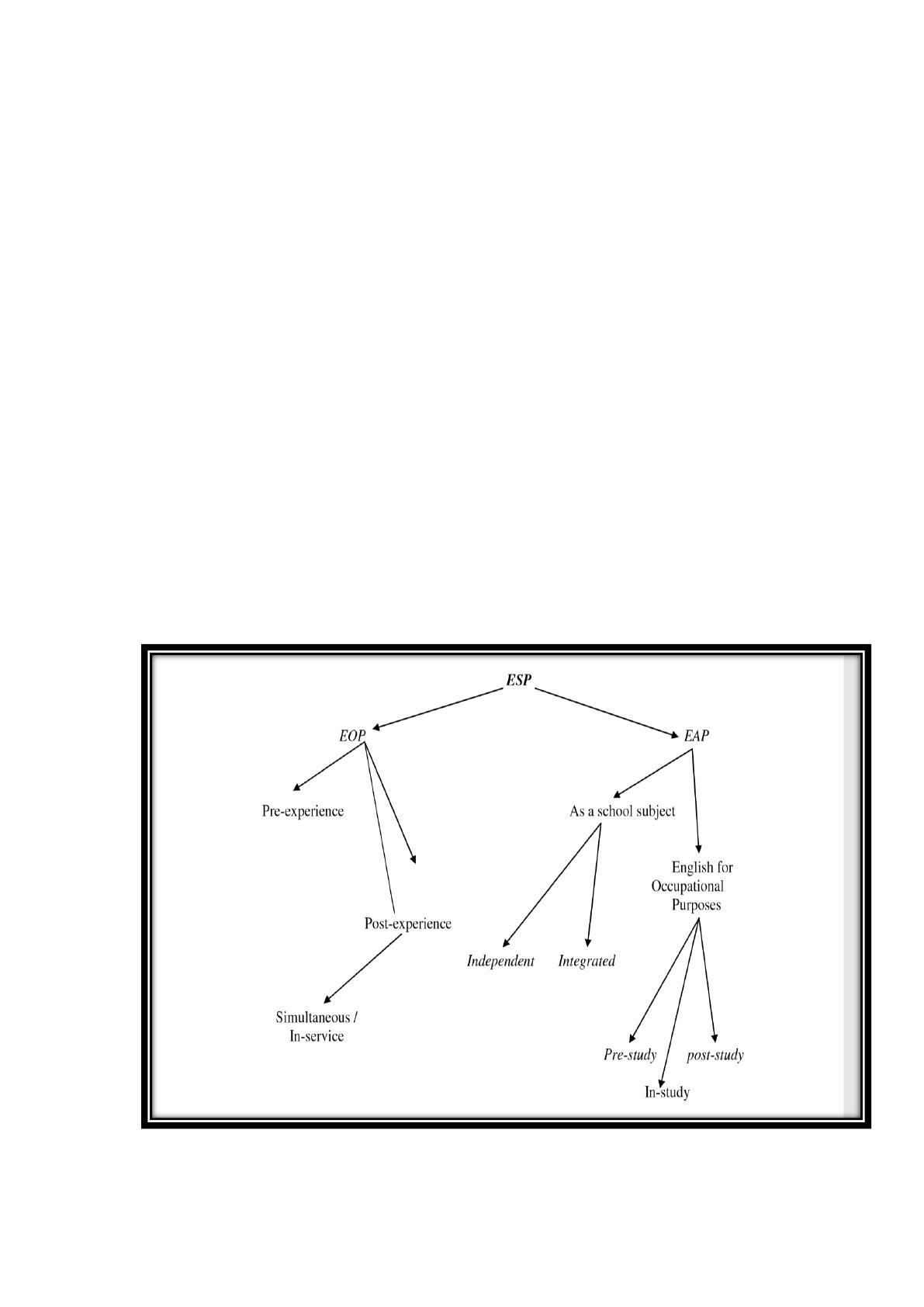
As a branch of applied linguistics consisting of a significant body of research
into effective teaching and assessment approaches, methods of analysis of the academic
language needs of students, analysis of the linguistic and discourse structures of
academic texts, and analysis of the textual practice of academics, ESP is divided into
two main areas according to when they take place (Figure 3) [7]:
1) English for Academic Purposes involving pre-experience, simultaneous/in-
service and post-experience courses, and
2) English for Occupational Purposes for study in a specific discipline (pre-
study, in-study, and post-study) or as a school subject (independent or integrated).
Pre-experience or pre-study course will omit any specific work related to the
actual discipline or work as students will not yet have the needed familiarity with the
content; the opportunity for specific or integrated work will be provided during in-
service or in-study courses.
Figure 3.
Types of English for Specific Purposes [7, p. 143]
In the view of Strevens EAP is a shift from teaching literature and culture of
speakers of English to teaching English language for communicative purpose. He
17
added that English language should be matched to the needs and purpose of learners.
[39].
EAP takes place in a variety of settings and circumstances. The students need
EAP for higher education. The teachers may be native or non- native speakers. The
course may be pre- sessional (full time), in- sessional and usually part time. It may be
a short term or long term. The course may include formal teaching program, self-access
situations, distance- learning materials or CALL (Computer Aided Language
Learning). General English course teaches learners conversational and social genres of
the language, whereas EAP course teaches formal academic genres and EOP course
teaches genres related to occupation. To be precise, EAP and EOP are specific because
they teach language skills required for learners’ immediate purpose by selecting
vocabulary, grammar pattern. In addition, they use the topic and themes that are
relevant to learners’ immediate needs and address learners’ immediate communicative
needs.
The classification of ESP courses creates numerous problems by failing to
capture fluid nature of the various types of ESP teaching and the degree of overlap
between common-core EAP and General English - e.g. Business English can be seen
as mediating language between the technicalities of particular business and the
language of the general public, which puts it in a position between English for General
Purposes and specialist English.
Therefore, some authors like Dudley-Evans and St John [12] suggest the
presentation of the whole of ELT should be on a continuum that runs from General
English courses to very specific ESP courses as illustrated in Table 1. Regarding
positions 2 and 3, it is only the overall context of the program that decides whether a
course is classified as ESP or not. At position 4, the work is specified in terms of the
skills (it is important to choose appropriate skills to focus on - e.g., some doctors will
need to read some medical journal, others will need oral skills to talk with their
patients) taught, but the groups are not homogenous from one discipline or profession
(scientists, engineers, lawyers, doctors), so the individual members can need texts
dealing with their specific profession. Teaching materials prepared need contexts


18
acceptable and understandable to all branches. At position 5 the course becomes really
specific – the key feature of such courses is that teaching is flexible and tailored to
individual or group needs.
Table 1.
Continuum of ELT Course Types [7]
General
Specific
Position 1
Position 2
Position 3
Position 4
Position 5
English for
Beginners.
Intermediate to
advance
English for
General
Purposes
courses with a
focus on a
particular skill.
English
courses based
on common
core language
and skills not
related to
specific
discipline or
profession.
Courses for
broad
disciplinary or
professional
areas (e.g.
Report writing
for Scientists
and Engineers,
Medical
English, Legal
English,
Negotiating
skills for
Business
English).
1) An academic
support course
related to a
particular
academic
course.
2) One-to-one
work with
businesspeople.
Considering the characteristics of ESP, he states that there are three
characteristics common to ESP courses:
1) authentic materials – the use of authentic learning materials is possible if we
accept the claim that ESP courses should be offered at an intermediate or advanced
level. The use of such materials, modified by teachers or unmodified, is common in
ESP, especially in self-directed studies or research tasks. The students are usually
encouraged to conduct research using a variety of different resources;
2) purpose-related orientation – refers to the simulation of communicative tasks
required by the target situation. The teacher can give students different tasks - to
19
simulate the conference preparation, involving the preparation of papers, reading, note-
taking and writing.
3) self-direction – means that ESP is concerned with turning learners into users.
For self – direction, it is necessary that teacher encourage students to have a certain
degree of autonomy – freedom to decide when, what, and how they will study. For
high-ability learners it is essential to learn how to access information in a new culture.
This learner-centered approach adapted in ESP courses has allowed for the
following changes in language teaching:
– inclusion of materials into a syllabus is based on the learners’ reasons for
learning;
– courses are more intensive;
– learners want to achieve good language competence in the shortest time
possible;
– learners can negotiate the syllabus;
– learning is understood as an active construction of meaning
– teaching is perceived as guiding, scaffolding, and facilitating learning
– real-life tasks are prioritized
– meaningful and purposeful interaction can be created through language;
– tasks are cognitively more challenging;
– learners have more autonomy;
– learners accept more responsibility for the outcome of the learning process;
– making vocabulary personal helps to make it more memorable.
Today we can still witness that demand for English for Specific Purposes
continues to increase and expand throughout the world. Learners need courses
matching their ever-growing needs and requirements resulting from what the labor
market demands [1].
Since ESP courses are of various types, depending on specific scientific field
or profession, and have specific features, the teachers teaching such courses need to
play different roles and acquire different knowledge for facing the requirements of
learners.
20
1.3 Strategies and Methods for Teaching ESP
Nowadays it is a debatable issue whether ESP has distinctive methods of
teaching [2, p. 114]. Some argue that English Language Teaching (ELT) and ESP differ
little and that it is not possible to say whether general ELT has borrowed ideas for
methodology from ESP or whether ESP has borrowed ideas from general ELT [ibid].
There are two characteristic features of ESP methodology: ESP can base
activities on students’ specialism, and ESP activities can (but may not) have a truly
authentic purpose derived from students’ target needs. Dudley-Evans and St. John
maintain that what characterizes ESP methodology is the use of tasks and activities
reflecting the students’ specialist areas. Post-experience ESP learners have specialist
knowledge from working or studying in their specialist areas and a ‘deep-end strategy’
[12, p. 190] can be used.
In a deepened strategy, students’ performance of a task is the point of departure
for instruction. Basturkmen’s presentation of ESP methodology is organized around
the concepts of input and output. These concepts are associated with information
processing views of second language acquisition [2, p. 114]. Based on these the
following ESP teaching strategies may be identified [ibid.]:
1. Input-based Strategies;
2. Input-to-Output based Strategies;
3. Output-based Strategies;
4. Output-to-Input based Strategies.
1. Input-based Strategies
Input based strategies rest on the idea that learning occurs primarily through
exposure to language input in the form of written or spoken texts and language
descriptions. Input is seen as a sine qua non of learning. Basturkmen identified two
distinct subcategories of input-based strategies. The first is premised on the idea that
input is sufficient for learning and the second on the idea that input needs to be followed
by student output for learning to occur [ibid., p. 115]. Learners are primarily provided
with language input in as much as exposure to it is understood to promote learning.
Learning comes about as the students see evidence (sometimes also termed positive
21
evidence) of how language works or how language is used in workplace, academic, or
professional target environments. Students do not need to be pushed into immediate
production in order to learn.
Basturkmen further views that teaching can simply provide positive evidence
about how language works or is used by exposing students to authentic texts and
engaging them in comprehension activities, or teaching can go beyond this simple
exposure to language input and aim to help students notice specific language features
or forms in it through the use of awareness-raising activities.
Using such activities, teachers should aim to direct students’ attention to the
targeted forms or features in the input so that the students will develop explicit
knowledge of them. The author points out a number of techniques for awareness
raising, such as input flooding (exposure to multiple samples of the feature) and input
enhancement (the feature is highlighted in the text).
Heightened awareness of the forms or features by the students is understood to
be beneficial. It is not expected that once students have become aware of a linguistic
item, they will immediately produce it, but rather that repeated noticing will enhance
learning.
Acquisition, results from the gradual and dynamic process of internal
generalization rather than from instant adjustments to the learner’s internal grammar.
It is important for learners to be re-exposed to language items in multiple samples over
time. The use of reading and listening texts are one way to achieve this. There can be
a gap between learners’ understanding or becoming aware of a linguistic item and
actually activating this knowledge into some form of production [2, p. 116].
2. Input to Output based Strategies
The author shows that in this strategy, students are provided with input as the
basis for production (output). The lack of sufficient use of this strategy can be inferred
in the following criticism made of methodology in ESP: A common failing in teaching
is to expect high level production without giving sufficient input. In this strategy, the
focus is on students acquiring explicit knowledge of preselected language items. The
teacher selects specific items (target linguistic forms or features) as the focus of