43
-----------------------------
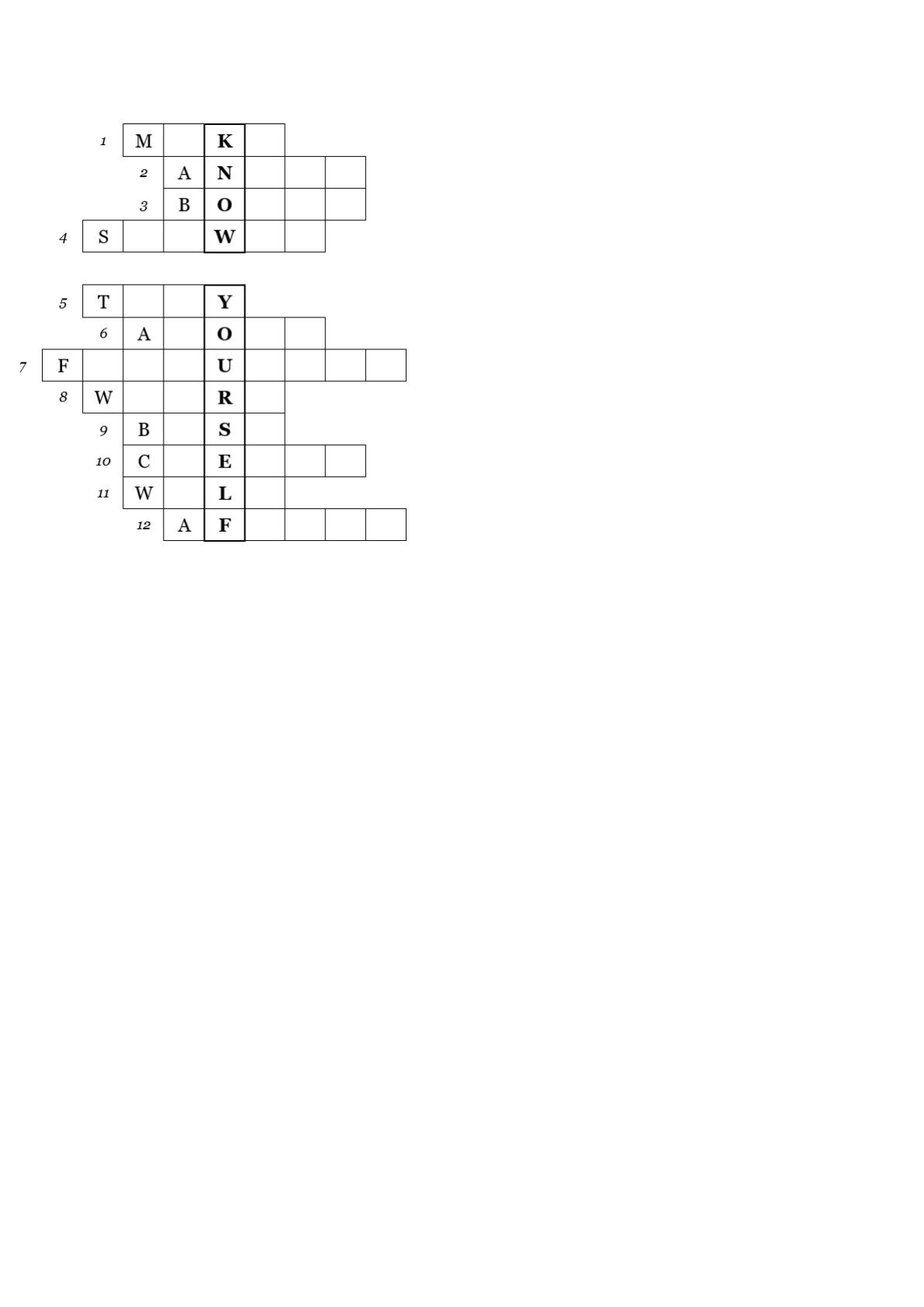
1. Can you _____________ friends
easily or does it take you a long time to get
to know people? 2. Are you the kind of
person who is always _____________ and
shouts all the time? 3. Do you quickly get
_____________ with things and never
finish them? 4. Do you do things quickly
or _____________? 5. What’s your room
like? Is it _____________ or is it messy?
6. Do you prefer to be _____________ or
with other people? 7. What is your
_____________ free-time activity? 8. Do you _____________ about things a lot?
Does it stop you sleeping? 9. Are you happiest when you are _____________ or
do you like having nothing to do? 10. Are you a _____________ person? What
subjects are you best at? 11. Do you get on _____________ with most people or
do you often disagree with people? 12. What things are you _____________ of?
What scares you the most?
Letter from an unexpected destination (the saint place). Please, write
down your reply with benediction for your close friend concerning his wish
to stay there and continue his learning of himself.
Dear Fiodor, hello, my dear friend. It’s been a long time we’ve seen each
other the last time.. and I certainly have something to refer you given my
prolonged absence.. for sure you had questions that ought to be answered and
thus.. I am to narrate you the ultimate events occurred into my life.. I have
reflected that if were not for the kindness my master Babadji in a yoga center for
starters in Singapore, all this would not have happened. I understood one especial
day that all my life wasn’t anything else than a waste of my time, origin of all my
depressions, I needed to get more answers that nobody could provide me with.. 3

44
years spent with alcohol, I’ve lost my job, my girlfriend left me cause I had no
ambitions, no way of thinking towards the future, I even could not explain to
myself what do I want, what for do I have to fight.. without any visible aim, no
perspective in my mind, I was lost to society, as you might remember dear Fiodor..
and then, I met my teacher named above.
I have to confess: this practice of yoga liberation is my heart practice, and
is something I have promised myself to continue doing till the end of my days. It
makes my life most meaningful, to be of service to my spiritual brothers, as well
as the liberation of Tibet and the whole humankind through local mental
practices. I would like now to inform you that I would like to continue to liberate
myself and therefore, consequently, it’s utterly probable that I will not come back
in the US to see once again my family and our pals in common. Please accept
this. If I am able to do it I will then pray to liberate all lives on Earth till everyone
is liberated. Please pray for me..
Waiting for your kind response and sending you my heartfelt hugs..
Your friend of youth, Jonathan
Lhasa, 01.12.23
Please find out and try to substitute pronouns (subject, possessive) in
the text below.
Although literary narratives are not true but invented, they are nevertheless
to some extent possible because – at least as for their structure. Here, in the realm
of as if, we can observe how ethics connect with aesthetics, how ethical questions
concerning actions, overlap with those, which are related to the world of literary
fiction. Identifying ourselves with fictitious heroes, we gain an opportunity of
exploring us in real life.
This way, we can imaginatively explore our own internal boundaries and
in consequence, better understand what we might do in various situations and
circumstances, which are our own possibilities, who we really are.


45
In my humble opinion, such a possibility of a mutual influence between
literature on the one hand and our real life on the other is an effect of the fact that
according to the scientists’ conception also has a narrative structure.
To sum up, literary, narrative fictions have their origins precisely in the
same world in which events and actions they imitate occur and talk about our
own possibilities, which are not true but in spite of that might be true. Although
literature presents fictitious, untrue stories, it may influence the real world and
shape your identity (yourselves).
We may experience fictitious stories and identify with their heroes and, on
the other hand, they may change and shape us because our own self also has a
narrative form – namely it is a kind of life story in which we ourselves are
narrators, storytellers.
Please, read keenly the next topic and try to recreate the missed parts
in particular paying high attention to context while proving to make a choice
between Present Perfect and the Past Simple.
My family and I (to move) from Yaroslavl’ to Moscow last autumn, so we
(to live) in the Russian capital for eleven months now. Honestly speaking, with
all due respect to my new hometown, I miss my friends in Yaroslavl’. In fact, my
best friend there is called Misha. We (to meet) at the local primary school, so I
(to know) him for a while now. Unfortunately, I (not to see) him since last
summer.
Currently, I go to Pushkin Secondary School based in the central district of
Moscow. I (to be) at the school since last September. At first I (not to like) it
because I (not to have) any friends here. But as time was passing by, my new
classmates showed me a warm respect and time after time I got invitations to
become a member of a plenty of afterschool clubs like chess, volleyball etc.
Please, read carefully the next topic and try to recreate the missed
parts in particular paying high attention to context while proving to make a
46
choice this time among three Present Tenses (Simple, Continuous and
Perfect).
Dear Maxim, hello, how de? It __ (to be) time since my last letter to you,
please forgive me, the point __ (to be) I __ (to be) really busy ultimately.
As you might keep in mind, I__ (still to work) at NTV national channel and
the company__ (to do well).
This is very fortunate as many of my friends due to the coronavirus
restrictions and, as a consequence, economic hardships, __ (to lose) their jobs. As
a result of all due measures taken by the Russian government, our savings__ (to
take) a disastrous dive because of the complete financial situation in the country.
I__ (to know) the situation everywhere is a bit arduous and I__ (to be) happy I
still have a job. My friend Nikolay and his wife (now to live) in Pskov. He __ (to
finish) studying massage therapy. They want to __ (to run) a small clinic in
partnership with another woman. In the meantime they both __ (to look) for a
full-time job in order to get more money and invest it as a starting capital for their
enterprise, though, as they state me periodically, because of lack of job offers
there, they tend to __ (to lose) money than spare anything for the future
perspective. Wrapping up all said above, many people in Russia __ (to have) a
hard time now.
Please, read advertently next sentences and try to recreate the missed
parts in particular paying high attention to context while proving to make a
choice this time between two Present Tenses (Perfect and Perfect
Continuous).
I (not to see) her for ages. She (to do) her school lessons since this
morning;
I (not to hear) about Mr. Ivanov for a pretty long time;
I (to drive) since I was 18 and now I (to be) 40 years old;
Peter (to fail) his driving test three times because he doesn't know
how to park outside the city;
47
I think he (to make) a lot of improvement recently since he stopped
to consume a lot of alcohol;
Anna (not to pass) her driving test because she doesn’t know the
rules well;
She (to get worried) about this for five months and nothing helps her
to relieve this pain;
You have to (to study) the driver’s manual for hours every day;
She (not to take) another test yet;
I (to have) a headache since I got up Tuesday morning;
He is my friend, I (to know) him for a long time;
Alexey apparently has a stomachache. He (to eat) junk food all day
instead of cooking something decent for himself as advised by us his closest
friends;
I (never to hear) that Russian opera before. It sounded brilliantly!
Please, read closely next sentences and try to recreate the missed parts
in particular paying high attention to context while proving to make a choice
this time among all four Present Tenses.
What time __ (the general meeting of shareholders to start)?
Tomorrow we __ (to fly) to Moscow to visit my cousin Nadia;
Right now, as I see, he __ (to talk) on the phone;
The Earth __ (not to go) round the Mercury;
I __ (not to look) for my cat Pushistik for 2 hours!
Could you please close the window? I’m afraid I __ (to freeze)
The man __ (to paint) the walls of our town hall all day long;
This new Italian coffee __ (to smell) good, I’ve got to admit it!
At the moment we __ (to take) a walk around a beautiful village near
the city of Podolsk’;
We __ (not to finish) our history project over story of Russian empire
yet;
48
Andrey __ (never to be) abroad till the present day! What a pity!
Our lovely school always __ (to close) for Easter holidays;
What __ (usually/you/do) in your free time, Tamara?
Look! Your younger brother Tolya __ (to steal) tomatoes in the
kitchen!
Please, take notice of the following situation and attempt to regain
back the missed Tenses.
Fiodor: Hi, Pal, oh, my gush, what’s wrong? You __ (to look) rather pale.
__ (to be) you feeling well?
Ivan: Not at all, frankly speaking, you know.. I __ (to be) sick most of the
night. Indeed I didn't sleep very well..
Fiodor: Oh I see.. What __ (to seem) to be the matter? __ (to be) it the flu?
Ivan: No, mate, I ought to suggest that it's something I __ (to eat). We __
(to visit) a new restaurant in the historical center last night and I must have eaten
something that __ (not to agree) with me! That’s so horrible!
Fiodor: __ (to be) it that new restaurant on Pokrovskaya Street?
Ivan: Actually, it was. Why do you __ (to ask)?
Fiodor: Because, Pavel and Zina (to celebrate) their anniversary there last
week and (to get sick) in the same way. Indeed, they (to reveal) me to feel
themselves ill the next day, too.
Ivan: Seems curious! Maybe the health authorities __ (should to
investigate) the place, what do you opine?
Fiodor: That's what I __ (to believe) to be correct. Two people with similar
problems in such a short time __ (can not to be) a simple pure coincidence!
На основе статьи CNN "5 вещей, которые нужно делать, когда вы в
депрессии" (Приложение 1), вот два упражнения на письмо, которые
включают новую лексику из текста. Эти упражнения направлены на
улучшение навыков письма, а также на укрепление понимания ключевых
концепций и терминов, связанных с депрессией и психическим здоровьем.

49
Для написания эссе и письма на тему "5 вещей, которые нужно делать,
когда вы в депрессии", основываясь на статье CNN, можно использовать
следующий список слов и фраз:
Unremittingly down (непрекращающееся уныние) - постоянное
чувство подавленности.
Appetite alteration (изменение аппетита) - изменения в пищевых
привычках.
Hopelessness (безнадежность) - отсутствие надежды или
оптимизма.
Psychotherapy (психотерапия) - метод лечения психических и
эмоциональных проблем.
Antidepressants (антидепрессанты) - лекарства, используемые для
лечения депрессии.
Interpersonal connections (межличностные связи) - отношения и
взаимодействия с другими людьми.
Persistent (настойчивый) - упорный, неуступчивый.
Chronic depression (хроническая депрессия) - длительное
депрессивное состояние.
Attitude of gratitude (отношение благодарности) - благодарное
отношение к жизни и окружающему миру.
Embrace appreciation (принять признательность) - принять и ценить
то, что у вас есть.
Lifestyle interventions (изменения образа жизни) - изменения в
повседневных привычках и образе жизни.
Bifurcated response (раздвоенная реакция) - различные способы
реагирования на одно и то же событие или лечение.
Incur risks (подвергаться рискам) - столкнуться с потенциальными
опасностями или негативными последствиями.
50
Cultivate habits (вырабатывать привычки) - развивать и укреплять
полезные привычки.
Exercise 1: Reflective Essay Task: Write a reflective essay on the importance
of seeking help for depression. Use the following new vocabulary from the
article: unremittingly, appetite, clinician, psychotherapy, antidepressants,
interpersonal connections, bifurcated, chronic depression, psychotherapy, attitude
of gratitude.
Guidelines:
Start by describing what depression feels like, using the term
unremittingly.
Discuss how changes in appetite and sleep patterns can be indicators of
depression.
Explain the role of a clinician in managing depression.
Compare and contrast psychotherapy and antidepressants as treatment
options.
Highlight the importance of interpersonal connections in coping with
depression.
Discuss the concept of bifurcated responses to antidepressant
medications and the challenge of chronic depression.
Conclude with the significance of developing an attitude of gratitude
and how it can help in depression.
Exercise 2: Persuasive Letter Task: Write a persuasive letter to a friend who is
reluctant to seek help for their depression. Use the following new vocabulary
from the article: persistent, supportive relationships, antidepressant,
psychotherapy, gratitude.
Guidelines:
Begin by expressing your concern and encouraging your friend to be
persistent in seeking help.
51
Emphasize the value of maintaining supportive relationships during
tough times.
Discuss the potential benefits of trying an antidepressant and the option
of switching if one doesn’t work.
Suggest considering psychotherapy as an alternative or complementary
treatment.
Conclude by encouraging your friend to practice gratitude and
explaining how this mindset can positively impact mental health.
These exercises not only help in understanding and using new vocabulary but
also provide insights into dealing with depression, emphasizing the importance
of treatment and support.
Перейдем к следующему способу использования аутентичных
материалов.
Pre-reading stage The aim of the pre-reading stage is to prepare students
for the text and activate their prior knowledge related to the topic. This stage
includes two key activities: a brainstorming session and a vocabulary exercise,
both conducted in English.
1. Brainstorming
Topic: "Health and Safety During the Holidays"
Objective: To engage students in thinking about the theme of the text and
to elicit their prior knowledge or opinions.
Procedure: Begin by asking open-ended questions to stimulate discussion.
For example: "What precautions do you usually take during the holiday season to
stay healthy?" "Why do you think it's important to update vaccinations, especially
around holiday times?" Encourage all students to contribute, ensuring a variety
of opinions are heard. Note down key ideas on the board for reference during the
post-reading discussion.
2. Vocabulary exercise
52
Objective: To introduce and familiarize students with key terms from the
article.
Procedure: Present key words from the article, such as "vaccination",
"Covid-19", "masks", "symptoms". Ask students to define these words or use
them in sentences. For example: "Vaccination: What does it mean? Can you make
a sentence using 'vaccination'?" "Covid-19: How has it affected holiday plans in
the past years?" For more advanced classes, discuss any related terms or
synonyms. Encourage students to note these terms for future reference in their
vocabulary journals. This pre-reading stage sets the groundwork for deeper
comprehension and engagement with the text, while also expanding the students'
vocabulary and encouraging active participation.
Возьмем статью CNN в качестве аутентичного материала
(Приложение 2):
Post-reading stage
After students have read the CNN article, the post-reading stage aims to
deepen their understanding of the content, reinforce vocabulary, and develop
critical thinking skills. This stage involves several activities, focusing on
comprehension, discussion, vocabulary application, critical thinking, and creative
expression.
1. Comprehension questions
Objective: To check understanding of the article's key points.
Procedure:
Ask specific questions about the article.
For example:
(a) “What does the article suggest as the best way to protect against viral
respiratory illnesses?”
(b) "Why might getting vaccinated be particularly important during the
holiday season?"