
42
in English. The teacher can exploit the students' knowledge of the subject matter in
helping them learn English faster.
Most authors agree that the ESP teachers’ works involve much more than
teaching. Dudley- Evans and St. John prefer the term ESP Practitioner as this definition
seems to be more detailed and complete. They distinguish the following roles of ESP
practitioners, presented below in Figure 4.
Figure 4.
The Role of the ESP Teacher [12]
ESP Teacher as Course Designer and Material Provider. Since it is rarely
possible to use a particular textbook without the need for supplementary material –
sometimes no really suitable published material exists for identified needs - ESP
practitioners often have to provide the material for the course. This involves selection
ESP
PRACTITIONER
Needs
Analysis
?
Teaching
Materials
Development
Research
Collaboration,
Negotiation
Syllabus
Design
Evaluation
43
of published material, adapting material if it is not suitable, or writing it. ESP teachers
also need to assess the effectiveness of the teaching material used whether it is
published or self-produced.
Due to the lack of materials for ESP courses, the ESP practitioner is expected
to plan his course well as per his need and accordingly provide the materials to his
students. The teacher’s task also includes adapting materials when published materials
are unsuitable, or his/her own materials lack the proper authenticity. With reference to
a particular classroom experience, the Design of the course shall be prepared. The
levels of attainment are described for each of the skills areas (listening, speaking,
reading and writing) as follows:
1. Survival Level – The person can use language for basic purposes in
extremely limited way.
2. The way stage level – The person can communicate very simply in limited
range of topics.
3. The Threshold level - The person can use the language for most everyday
situations and topics at simple level.
4. The Adequacy Level-The person can use the language for range of situations
and topics and can show awareness of appropriate style and variety.
5. Proficiency Level- The person can respond flexibly to complex ideas and
expressions.
6. The Mastery Level- The person has no problem in using the language.
7. The Ambi-lingual Level- The person’s use of language is indistinguishable
from that of any educated native speaker.
In Hutchinson and Waters’ view ‘much of the work done by ESP teachers is
concerned with designing appropriate courses for various groups of learners. Thus,
whereas course design plays a relatively minor part in the life of the General English
teacher – course here usually being determined either by tradition, choice of textbook
or ministerial decree – for ESP teacher, course design is often a substantial and
important part of the workload’ [22, p.21].
Hutchinson and Waters consider that ESP course designing is ‘fundamentally

44
a matter of asking questioning in order to provide a reasoned basis for the subsequent
processes of syllabus design, material writing, classroom teaching and evaluation’
[ibid, p.21]. They explain that the ESP teacher needs to have the knowledge about
several things, such as why the student needs to learn, who is going to be involved in
the process, what the student needs to learn, what aspects of language will be needed,
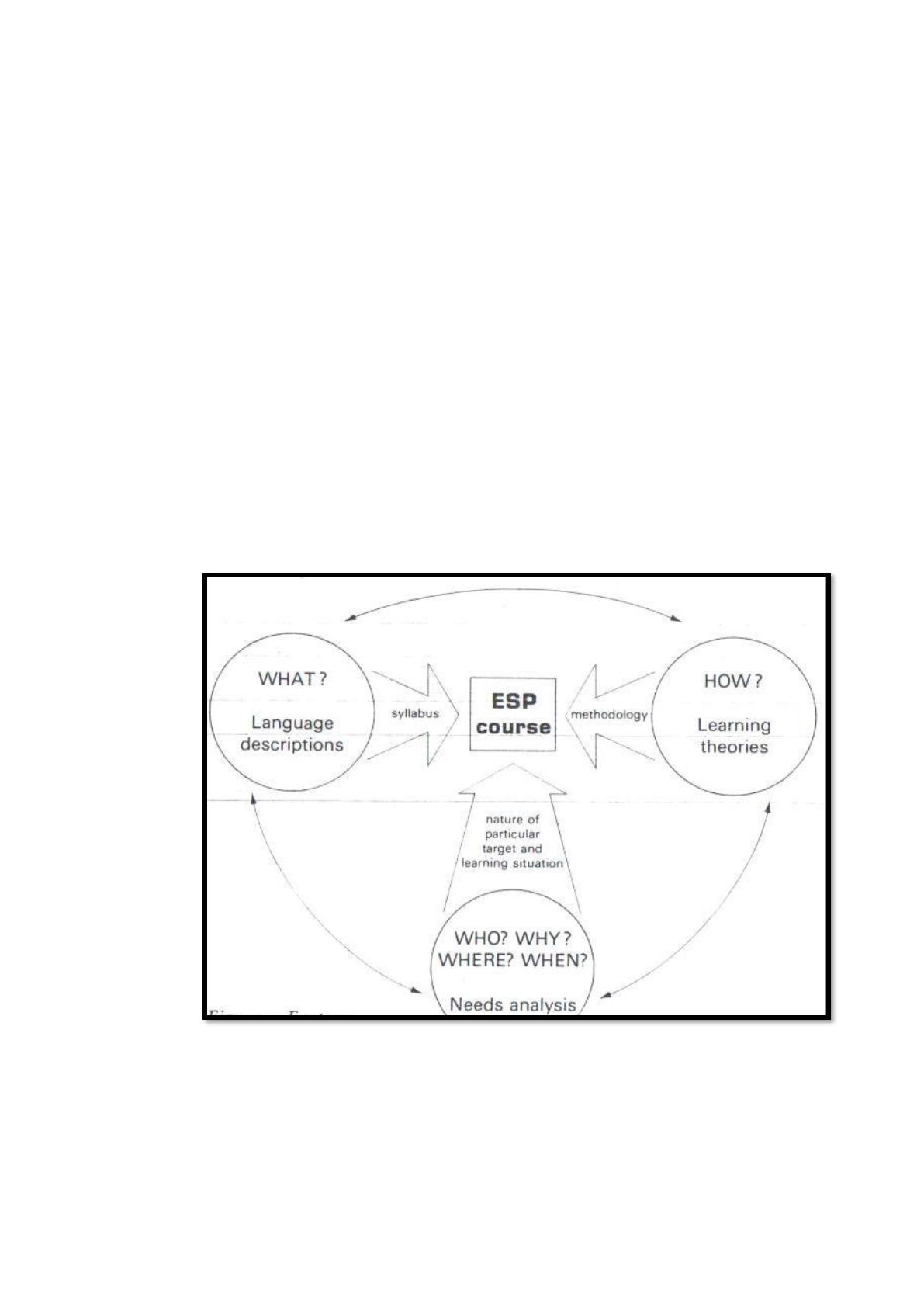
and many others. Having investigated the questions an ESP teacher should ask himself,
Hutchinson and Waters summarized them under three categories: Language
Descriptions, Theories of Learning and Needs Analysis. Even though these three items
look like separate entities, their interdependence in the syllabus design process is of
greatest importance. Schematically, they show their relationship in the following
manner:
Figure 5.
Factors Affecting ESP Course Design [14, p. 22]
Considering these factors helps ESP providers better understand what to focus
on in their course design, while designing an ESP course, it is of paramount importance
to appropriately identify the course goals and their ‘enabling’ objectives. Well-stated,
clear goals and objectives are fundamental to both teaching and learning, as they hold

45
teachers accountable for what their students learn. Objectives, whether they are called
‘enabling’, learning, behavioral, instructional, or performance are terms that refer to
descriptions of student performance that are used to make inferences about learning
4
.
There are two particularly useful theoretical frameworks that can help ESP
teachers to write appropriate goals and objectives. The first one is that of
communicative competence that supposes the ability to use language correctly and
appropriately in order to accomplish a communication goal.
The second framework is that of the Communication Task / Language Analysis,
which uses the construct of communicative competence to break down a
communication task, identified through an ESP needs assessment, into its separate
areas of competency or skills. With this information, the ESP teacher can write
measurable enabling objectives for each performance goal.
Teachers can also use Heinrich’s The ABCD method of writing clear and
measurable objectives. The ABCD method of writing objectives is an effective tool for
writing objectives. In this system, "A" is for audience, "B" is for behavior, "C" for
conditions and "D" for degree of mastery needed.
1. Audience (A) – Who? Who are your learners?
2. Behavior (B) – What? What do you expect them to be able to do?
3. Condition (C) – How? Under what circumstances or context will the learning
occur? What will the student be given or already be expected to know to
accomplish the learning?
4. Degree (D) – How much? How much will be accomplished, how well will
the behavior need to be performed, and to what level?
5
Once the behaviors, conditions and degrees of mastery for each objective are
established, the ESP teacher can use them to determine what types of assignments, tests
or alternative assessment he / she should use in the course, thus tying the objectives
with evaluation.
4
Kizlik B. How to Write Learning Objectives that Meet Demanding Behavioral Criteria, Fl: Adprima, 2016 –
[electronic resource], - http://www.adprima.com/objectives.htm.
5
Pleska Galina, Identifying ESP Course Goals and Their Objectives, [electronic resource], -
https://www.academia.edu/32987629/Identifying_ESP_Course_Goals_and_their_Enabling_Objectives.doc.
46
Concluding all the things mentioned above, it can be stated that the importance
of identifying and formulating goals and objectives derives from the fact that they can:
▪ help the ESP teacher / provider build a clear vision of what he /she will teach;
▪ help the ESP teacher / provider to define priorities and to make choices about
what to teach and how to teach;
▪ hold the ESP teacher / provider accountable throughout the course;
▪ provide the basis for the assessment plan.
Consequently, clear goals make teaching purposeful while clear objectives
serve as a bridge between needs and goals.
ESP Teacher as Researcher. Research has been particularly strong in the area
of EAP (genre analysis). Regarding the research into English for Business Purposes,
there is a growing interest in investigating the genres, the language and the skills
involved in business communication. ESP teachers need to be in touch with the
research. Teachers carrying out a needs analysis, designing a course, or writing
teaching materials need to be capable of incorporating the findings of the research, and
those working in specific ESP situations need to be confident that they know what is
involved in skills such as written communication.
ESP Teacher as Collaborator. It is believed that subject-specific work is often
best approached through collaboration with subject specialist. This may involve
cooperation in which ESP teacher finds out about the subject syllabus in an academic
context or the tasks that students have to carry out in a work or business situation. Or
it may involve specific collaboration so that there is some integration between
specialist studies or activities and the language. It might involve the language teacher
specifically preparing learners for the language of subject lectures or business
presentations.
Another possibility is that a specialist checks and comments on the content of
teaching materials that the ESP teacher has prepared. The fullest collaboration is where
a subject expert and a language teacher team-teach classes; in EAP such lessons might
help with the understanding of subject lectures or the writing of examination answers,
essays or theses, while in EOP they might involve the language teacher and a business
47
trainer working together to teach both the skills and the language related to business
communication.
ESP Teacher as Analyzer. Because ESP focuses on teaching specific language
and communication skills, ESP course design usually includes a stage in which the
course developers identify what specific language and skills the group of language
learners will need. The identification of language and skills is used in determining and
refining the content for the ESP course. This process is termed “needs analysis”.
ESP Teacher as Evaluator. The ESP practitioner is often involved in various
types of evaluation - testing of students, evaluation of courses and teaching materials.
Tests are conducted: 1) to assess whether students have the necessary language and
skills to undertake a particular academic course or career which is important in
countries such as the UK, USA, Australia where large numbers of international
students do postgraduate course or research and need internationally required tests, e.g.
International English Language Test Service (IELTS), Test of English as a Foreign
Language (TOEFL), and 2) to assess the level of their achievement – how much
learners have gained from a course.
Evaluation of course design and teaching materials should be done while the
course is being taught, at the end of the course and after the course has finished, in
order assessing whether the learners have been able to make use of what they learned
and to find out what they were not prepared for. Evaluation through discussion and on-
going needs analysis can be used to adapt the syllabus.
ESP teachers are not specialists in the field, but in teaching English, their
subject is English for the profession but not the profession in English. They help
students, who know their subject better than the teachers do, develop the essential skills
in understanding, using, and/or presenting authentic information in their profession. A
professional ESP teacher must be able to switch from one professional field to another
without being obliged to spend months on getting started. He/she simply brings the
necessary tools, frameworks, and principles of course design to apply them to new
material. The material (the content) should be provided by the professors or experts in
the subject. It should always be authentic (the main purpose of teaching skills is to

48
enable students to deal with authentic information despite their level of English), up-
to-date (the informational exchange is growing more intense), and relevant for the
students’ specializations (they ought to be given the information representative for their
target language use situation).
Most teachers continuing their career as ESP teachers will have to pursue
continuing personal education. The first and most essential piece of information that
can be offered to novice ESP teachers is that they will have to learn many new things
they were not taught during their university years. And they will have to continue
learning throughout their professional life. As simple as that. As demanding as that.
The bar for qualified ESP teaching is going higher and higher. The idea that ESP is a
general language plus specialized vocabulary, advocated by some laymen, has already
been rejected. University teachers who think that in ESP teaching they are not
responsible for transferring area specific knowledge are in a slim minority now.
Teachers must understand the meaning of specialized terms, they have to know
and understand the basic facts, mechanisms and processes they discuss with their
students, and they have to have some rudimentary knowledge in the subject matter they
teach. In order to increase the effectiveness of the courses they teach, ESP teachers are
expected to learn many new things that will help them make their teaching better and
more effective.
These include learning:
▪ how to respond to learners’ needs;
▪ how to teach non-linguistic skills (pragmatic and sociolinguistic skills);
▪ what to prioritize in an ESP course (high-frequency lists);
▪ how to select and incorporate authentic materials into the course;
▪ how to evaluate teaching materials using quantitative methods;
▪ how to make use of online materials and social networks;
▪ what new teaching techniques to implement (e.g. case studies);
▪ how to teach for ESP certificate exams;
▪ how to teach effective writing for professional purposes.
49
ESP teachers need to put a lot of time and energy into being better performers
in what they do professionally. It can be achieved by either self-education, by
collaborating with and learning from subject matter specialists, by taking postgraduate
courses offered to novice ESP teachers or by enrolling for doctoral studies either in
ESP or in the subject matter. Witnessing so many developments in ESP teaching, it can
be assumed that the potential for growth is huge. ESP teachers who will follow these
developments and who will be open to possible challenges in the future are likely to
succeed.
Teachers need to change and develop – changes lead to improvements in the
quality of ESP teaching. Changes should not be avoided; change resistant teachers find
it difficult to adapt to the changing needs of their students, to develop, and improve as
ESP teachers.
3.2 Peculiarities of Teaching ESP with Case Studies. Advantages and
Disadvantages of Teaching with Cases
English for Specific Purposes refers to the teaching and learning of English as
a second or foreign language where the goal of the learners is to use English in a domain
[7]. The use of case studies in teaching English for Specific Purposes is a prime
example of a learner-centered approach. This learner-centered approach provides
students with lots of opportunities to practice analytical and creative thinking, problem
solving, and decision making. It teaches critical and constructive thinking, evaluation
and forecasting and thus contributes to the development of conceptual thinking. It
encourages students to defend their ideas and to reflect on their thinking when they
take decisions, critically compare, and evaluate options or design an action plan. It also
allows them to compromise and reach a consensus when they work in teams.
The case study method is used extensively in law, medicine, psychology,
economics, management, and in finance. It is also used in other varieties of ESP. A
didactic case presents a real-life problem that either has been solved or needs to be
solved. It gives some background information to the problem. It often contains some
data in the form of graphs, documents, interviews, tables, etc. that may be helpful in
identifying the problem and in solving it.
50
ESP case studies are always oriented towards communication necessary for
dealing with the problem under investigation. The process of teaching ESP with case
studies may be divided into three parts [13]:
The case study introduction - this part deals with the preparation of the case,
the introduction of a problem-solving analysis and the pre-teaching of language
specific vocabulary.
The case study class – the class will be divided into sections to include
meetings, presentations of findings and discussions of recommendations.
The class debriefing - the teacher will give feedback on language mistakes,
managerial skills, documents and support materials used.
The way in which a Case Study is prepared and introduced into a ESP class is
one of the major stages for a successful outcome. It should be prepared in advance by
the teacher, so that each student knows what his role is. It is not sufficient just to give
the case study to the students and rely on the fact that they will understand it on their
own. This is a common mistake that teachers make during the case study teaching
process. The way to introduce the case study depends on the decision of the teacher
only, however it is very important that the teacher completes the following three steps
during the introduction class [ibid.]:
1. Reads the case study thoroughly with the students;
2. Provides the students with an input on how they should analyze the case study;
3. Pre-teaches the language required to discuss the case study
1. The teacher reads the case study thoroughly with the students. The teacher
deals with lexical and grammatical issues at this stage. It is important to ask the students
to represent the background information in a visual form, using blackboards and
flipchart, for getting a clear picture of the company. The main information shall be
extracted from the case study itself; these data will be later used for further analysis.
2. The teacher provides the students with an input on how they should
analyze the case study. The steps presented below helps the students to analyze the
case critically:
a) read the case several times;
51
b) define the main issues and problems;
c) set out the company’s objectives;
d) identify the company’s options;
e) draw up a set of criteria to evaluate the options;
f) select the best option;
g) decide on how the option should be implemented;
h) draw up an action plan to implement the solution chosen.
3. The teacher pre-teaches the language required to discuss the case study.
The teacher shall focus on the specific skills the case study is intended to teach (meeting
skills, presentation skills, negotiation skills etc.) and teaches the specific language.
During the case study class, the second part of teaching ESP process, the
teacher shall divide all students into small groups (usually 2 groups, on average 5-6
students in a group) to discuss the aspects of the case study. It is important that the
teacher reminds the students that they need to solve the problem on the basis of the
available information (though this might be not all the information they need to solve
the case), to make recommendations and come to preliminary decisions. It is also useful
to make analogy with real life business, wherein real-life situations many facts are
lacking, but the problems have to be solved. The class time is usually divided into
three slots: meeting, presentation and discussion. Meeting usually takes 25 minutes and
groups meet to discuss their part of the case study, the students will select a chairperson
to lead the meeting and will also draw up an agenda. Students discuss and provide
recommendations, which they then represent graphically on boards, flipcharts, or if
using computers, on the screen. The teacher’s task is to watch passively the students
and make notes on their activity. The teacher shall require from students that visuals
be clear, concise and coherent without long sentences. The students should then prepare
their presentation. The teacher shall also watch that all students have equal time of
speaking [ibid].
The Presentation will take about 15 minutes. One group presents its findings to
the other group and vice versa. Students must take notes in order to participate actively
in the third part of the lesson. This section should be treated as information exchange