164
the towel and falling in with the herd at the top. The analysis quoted above was
published eight days after the Dow’s all-time high of 2007. Even as the biggest
collapse in the stock market since the Great Depression took hold, net optimism
among advisors persisted all the way into March 2008, adding another five months to
the durations depicted by the data point in the upper right of Figure 25. When the
optimists finally paid the piper, they did so commensurately with their preceding
excess.
The ideal way to avoid being too early in expecting a trend change in the face
of unrelenting optimism or pessimism recorded in sentiment indicators is to interpret
the market’s waves correctly. My coverage of the stock market during my career has
provided several good examples of how it’s not done. Chapter 22, covering Elliott
Wave International’s analyses of the oil market, offers a good example of how it is
done.
Socionomic theory is unique in explaining why such sentiment extremes occur.
In contrast to the exogenous-cause mindset, we understand that sentiment readings
are results, not causes. They don’t determine where the stock market goes; the mood
driving the stock market determines where the sentiment indicators go. The higher
the degree of the largest culminating wave, the greater the sentiment extreme will be.
Is Linear Projection Truly an Exercise in Prediction?
Linear forecasters are never actually right, because in fact they are not
forecasting. Linear projections are merely descriptions of past trends and current
conditions. Voicing them takes no special ability and has no value. It’s just reading
out loud.
Ironically, because economists are always predicting the past trend to continue,
they can rightfully say, “We are right most of the time.” This is because of the
implication of Figure 1 in Chapter 7: Social conditions follow social mood closely,
and social mood has trends. Therefore, once economists belatedly recognize a new
trend, they will appear to be “right” as long as that trend remains in force.
165
Even though the practice of trend-following makes economists appear correct
about the direction of the trend, say, 80% of the time, they are really never correct at
all. We can understand this point more easily through analogy. Suppose there are two
sets of forecasters on a train traveling through fog: a socionomist in the cab of the
locomotive and a pack of economists in the caboose. Their job is to anticipate curves
in the track so the engineer can slow the train in time to negotiate them. The
economists are looking out the rear window saying, “The track is still straight as an
arrow behind us, so we predict more of the same.” Since curves in the track are few
and far between, extrapolating past trends in linear fashion makes the economists
appear correct most of the time, simply because the caboose is often going in the
same direction as the locomotive. The socionomist in the cab can’t see very well
because of the fog, so he makes several cautious suggestions for naught, but when the
curves arrive he can see them clearly. Although his forecasting record is imperfect, he
is in no way condemned to miss all the turns as the economists are.
First question: Who is actually in the forecasting business? Who even has a
chance to be right?
Second question: Who truly has the better track record? If the socionomist sees
the curves in time to slow the train before it careens off the rails, he has provided an
important service. Economists in the caboose cannot possibly anticipate any curves.
For the task at hand, they are never right. When your life or livelihood depends upon
advice, hind-casting is not an option. It is nothing.
In 2007 and early 2008—as detailed in Chapter 5—the most educated
economists in the profession predicted that the macroeconomic “track” was still
pointing straight ahead. Like their colleagues in the caboose, they were simply
describing the state of the past while marketing it as a prediction. Figure 26 shows
that people relying upon such statements suffered terrible injury when the train
careened off the rails and crashed.

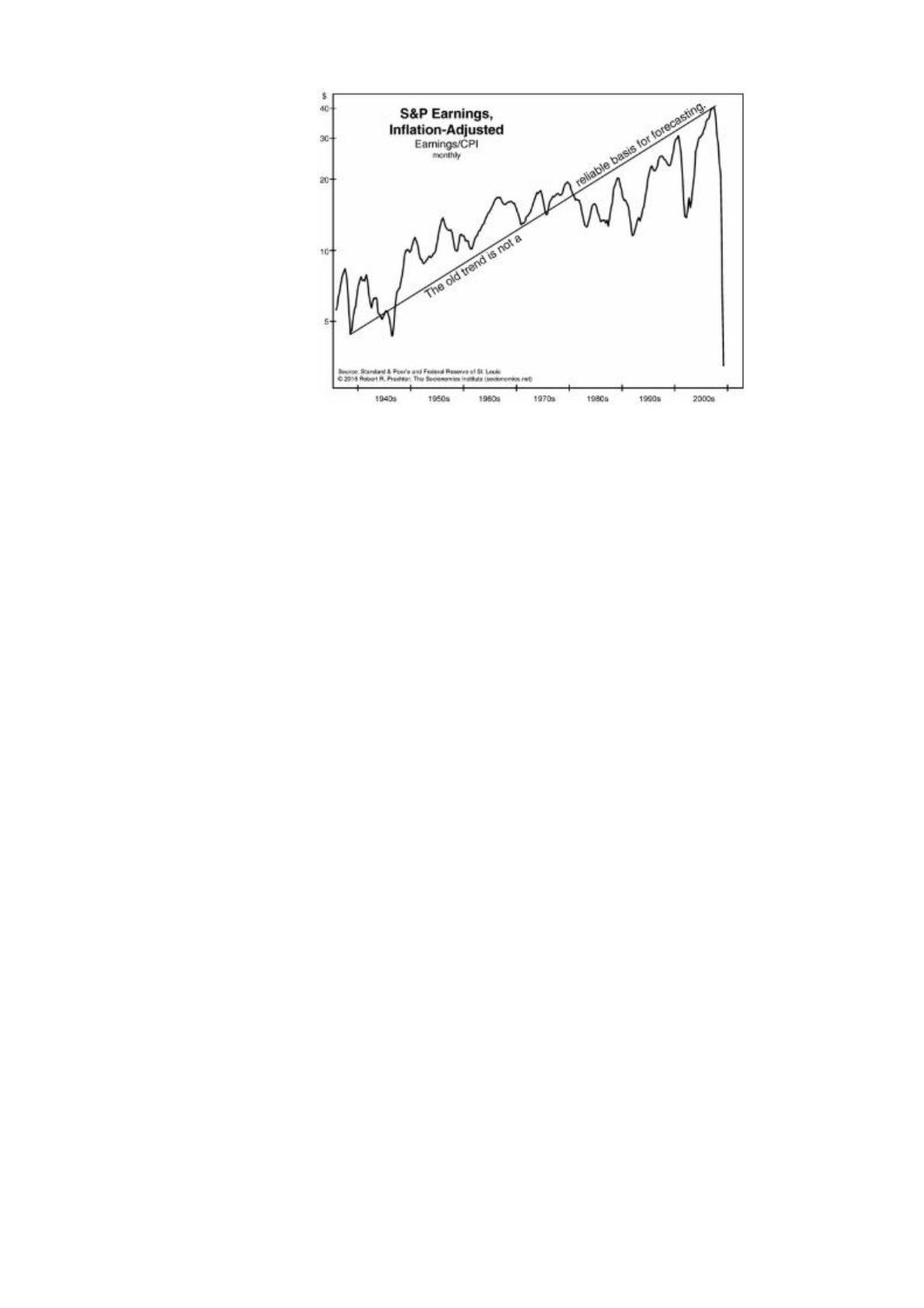
166
Figure 26
Consequences matter. In the real world, ill-timed business expansion can lead
to corporate bankruptcy. Inordinate caution at the end of an economic contraction can
lead to missed opportunity. Business people need timely warnings. They never get
them from linear forecasters. Fractal forecasting is a more useful alternative.