124
Давайте используем пиковое значение 1929 года, величайшей вершины
19-го и 20-го веков, в качестве ориентира. На максимуме 1987 года быки
правили в течение трех лет, но всего через три месяца после того, как годовая
дивидендная доходность от промышленного индекса Доу-Джонса упала ниже,
чем в 1929 году, рынок рухнул. При максимуме 2000 года дивиденды были
ниже уровня 1929 года в течение целых шести лет, но продолжительность
перевеса быков составляла всего 1,25 года. Этого было достаточно, чтобы
индекс “S&P” упал вдвое, а “NASDAQ” рухнул на 78%.
Здесь, в октябре 2007 года, быки среди консультантов постоянно
превосходили численность медведей в течение 9 лет с невероятным
соотношением еженедельных показаний 51/52, а дивидендная доходность была
ниже, чем в 1929 году в течение 13 лет. Таким образом, оптимизм не только
исторически экстремален с точки зрения масштабов, но и – в огромных
количествах – по продолжительности, затмевая весь предыдущий опыт.
Состояние, описанное выше, было тревожным, потому что я ошибочно
занимал медвежью позицию протяжении внутрикоррекционного ралли (волна
B) в 2003-2007 годах. Тем не менее, смысл этих показаний помешал мне
остановиться и присоединиться к стаду на вершине. Приведенный выше анализ
был опубликован через восемь дней после рекордного максимума Доу 2007
года. Несмотря на самый крупный обвал на фондовом рынке со времен
Великой Депрессии, чистый оптимизм среди консультантов сохранялся вплоть
до марта 2008 года, добавив еще пять месяцев к продолжительности,
изображенной точкой данных в правом верхнем углу рисунка 25. Когда
оптимисты наконец заплатили по счетам, они сделали это соизмеримо с
предыдущим избытком.
Идеальный способ избежать преждевременного ожидания изменения
тренда перед лицом неумолимого оптимизма или пессимизма,
зафиксированных в индикаторах настроений, – правильно интерпретировать
волны рынка. Мое освещение фондового рынка в течение моей карьеры
предоставило несколько хороших примеров того, как это не надо делать. В
125
главе 22, посвященной анализу нефтяного рынка “Elliott Wave International”,
приводится хороший пример того, как это делается.
Социономическая теория уникальна в объяснении, почему возникают
такие крайности настроения. В отличие от мышления экзогенной причинности,
мы понимаем, что показания чувств – это результаты, а не причины. Они не
определяют, куда идет фондовый рынок; настроение, управляющее фондовым
рынком, определяет, куда идут индикаторы настроений. Чем выше степень
самой большой кульминационной волны, тем больше будет экстремальное
настроение.
Является ли линейная проекция действенным инструментом
прогнозирования?
Линейные прогнозисты никогда не бывают правы, потому что на самом
деле они не прогнозируют. Линейные проекции – это просто описания
прошлых тенденций и текущих условий. Озвучивание их не требует особых
способностей и не имеет значения. Это просто чтение вслух.
По иронии судьбы, поскольку экономисты всегда предсказывают
продолжение прошлой тенденции, они могут с полным правом сказать:
«большую часть времени мы правы». Это связано с тем, что на Рисунке 1 в
главе 7 подразумевается, что социальные условия тесно связаны с социальным
настроением, а социальное настроение имеет тенденции. Поэтому, как только
экономисты запоздало признают новую тенденцию, они будут казаться
«правыми» до тех пор, пока эта тенденция остается в силе.
Хотя практика следования за трендом заставляет экономистов выглядеть
правильно относительно направления тренда, скажем, в 80% случаев, на самом
деле они вообще никогда не бывают правы. Этот момент легче понять по
аналогии. Предположим, в поезде, идущем сквозь туман, есть два типа
прогнозистов: социономист в кабине локомотива и толпа экономистов в
камбузе. Их работа состоит в том, чтобы предвидеть изгибы на пути, чтобы
инженер мог вовремя замедлить поезд, чтобы успеть их преодолеть.

126
Экономисты смотрят в заднее стекло и говорят: «Трасса позади нас все еще
прямая, как стрела, поэтому мы предсказываем, что впереди будет то же».
Поскольку изгибы на рельсах редки и находятся далеко друг от друга,
экстраполяция прошлых тенденций линейным способом заставляет
экономистов казаться правыми большую часть времени просто потому, что
вагон часто идет в том же направлении, что и локомотив. Социономист в
кабине не очень хорошо видит из-за тумана, поэтому он делает несколько
осторожных предположений напрасно, но когда появляются изгибы, он видит
их ясно. Хотя его прогнозы несовершенны, он никоим образом не обречен
пропустить все повороты, как экономисты.
Первый вопрос: Кто на самом деле занимается прогнозированием? У кого
вообще есть шанс быть правым?
Второй вопрос: у кого действительно лучший послужной список? Если
социономист видит повороты вовремя, чтобы замедлить поезд, прежде чем он
сойдет с рельсов, он делает важную работу. Экономисты в камбузе не могут
предвидеть никаких поворотов. Они никогда не подходят для поставленной
задачи. Когда ваша жизнь или средства к существованию зависят от совета,
смотреть в заднее стекло не вариант.
В 2007 и начале 2008 года, как подробно описано в главе 5, наиболее
образованные экономисты предсказывали, что макроэкономический «путь» все
еще указывает прямо вперед. Как и их коллеги в служебном вагоне, они просто
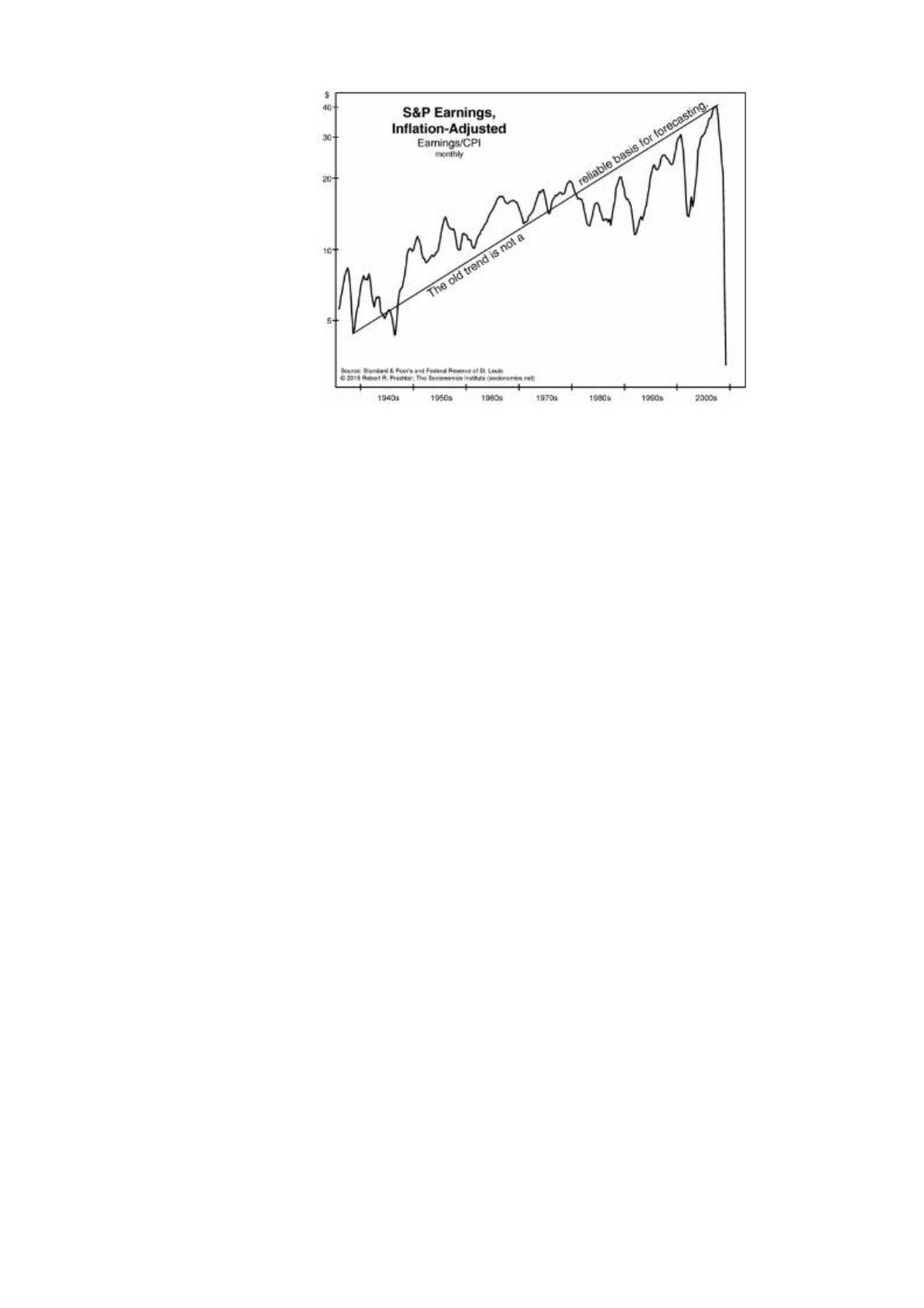
описывали состояние прошлого, продавая его как прогноз. Рисунок 26
показывает, что люди, полагающиеся на такие заявления, получили ужасные
травмы, когда поезд сошел с рельсов и разбился.
127
Рисунок 26
Последствия имеют значение. В реальном мире несвоевременное
расширение бизнеса может привести к банкротству корпораций. Чрезмерная
осторожность в конце экономического спада может привести к упущенной
возможности. Деловые люди нуждаются в своевременных предупреждениях.
Они никогда не получают их от линейных прогнозистов. Фрактальное
прогнозирование – более полезная альтернатива.
Оригинал текста для перевода
Chapter 21: Linear Extrapolation vs. Fractal Extrapolation
Robert R. Prechter
In March 2004, I asked an audience at the London School of Economics these
four questions:
(1) In 1950, a good computer cost $1 million. In 1990, it cost $5,000. Today it
costs $1,000. Question: What will a good computer cost 50 years from today?
128
(2) Democracy as a form of government has been spreading for centuries. In
the 1940s, Japan changed from an empire to a democracy. In the 1980s, the Soviet
system collapsed, and now Russia holds multi-party elections. In the 1990s, China
adopted free-market reforms. In March of this year, Iraq, a former dictatorship,
celebrated a new democratic constitution. Question: Fifty years from today, will a
larger or smaller percentage of the world’s population live under democracy?
(3) In the decade from 1983 to 1993, there were ten months of recession in the
U.S.; in the subsequent decade from 1993 to 2003, there were 8 months of recession.
In the first period, expansion was underway 92% of the time; in the second period, it
was 93%. Question: What percentage of the time will economic expansion take
place during the decade from 2003 to 2013, and from 2013 to 2023?
(4) In 1971, Reserve Funds kicked off the hugely successful money market
fund industry. In 1973, the CBOE introduced options on stocks. In 1977, Michael
Milken invented junk bond financing. In 1982, stock index futures and options on
futures began to trade. In 1983, options on stock indexes became available. Keogh
plans, IRAs and 401k’s have brought tax breaks to the investing public. The mutual
fund industry, a small segment of the financial world in the late 1970s, has attracted
the public’s invested wealth to the point that there are more mutual funds than there
are stocks on the NYSE. Futures contracts on individual stocks have just begun
trading. Question: Over the next 50 years, will the number and sophistication of
financial products and services increase or decrease?
Observe that I asked an economic question, a political question, a socionomic
question and a financial question.
Linear Trend Extrapolation
Most responders extrapolated their answers linearly from the trends of previous
data. They expected cheaper computers, more democracy, economic expansion 93%
of the time, and an increase in financial sophistication.
129
People think it is sensible to answer such questions by linear extrapolation
because they default to the mechanics paradigm when predicting social trends. They
think, “The social trajectory will remain constant unless impacted by an outside
force, and I don’t perceive any outside forces that could change these trajectories.”
This mode of thought, which is the basis for standard social science, is deeply
embedded in our minds because it has tremendous evolutionary advantages. When
Og threw a rock at Ug back in the cave days, Ug ducked. He ducked because his
mind understood the consequences of the Law of Conservation of Momentum, which
is that an object will maintain its trajectory unless acted upon by an outside force.
The rock heading towards him would not veer off course because there was nothing
between the two men to act upon it, and rocks do not have minds of their own. Earlier
animals that evolved to have an intuitive understanding of the laws of physics lived;
those that didn’t died, and their inabilities were weeded out of the gene pool.
Knowledge of physics makes possible our modern technological world. People rely
on it every day in handling objects. But social trends are not physical entities. As Paul
Montgomery of Universal Economics explained, the Law of Conservation of
Momentum is inapplicable to predicting social change, because the “rocks” in this
case—people—do have minds of their own.
Viewing social trends as if they were physical objects in motion perpetuates
two fallacies:
(1) extrapolating current trends into the future, and
(2) believing that an event must happen to change a trend’s direction.
The fallacies of trend extrapolation and exogenous causality lie behind all the
forecasting failures of conventional futurists.
For most people in most circumstances, the proper answer to each of the above
questions is, “I don’t know.” (Fractal projection and knowledge of socionomic
causality, however, can give you an edge in social prediction, as we will soon see.)

130
To get a feel for how useless—even counterproductive—linear extrapolation
can be in social forecasting, consider these circumstances:
(1) It is 1886. Project the future of the American railroad industry.
(2) It is 1975. Project the future of China.
(3) It is 1963. Project the cost of medical care in the U.S.
(4) It is 1969. Project the future of the U.S. space program.
(5) It is 100 A.D. Project the future of Roman civilization.
In 1886, a futurist would have envisioned a landscape combed with rail lines
connecting every city, town and neighborhood. Small trains would roll around to
your home to pick you up, and a network of rail lines would help deliver you to your
destination efficiently and cheaply. Super-fast trains would make cross-country runs.
You could eat, work, read or sleep along the way.
Is that what happened? Would anyone have predicted—did anyone predict—
that trains in 2015 would often be going slower than they did in 1886, that they would
occasionally jump the tracks, that they would be inefficient, that they would have
little food and few sleeper cars, and that the equipment would be old and worn out?
In 1975, the Communist party was entrenched in China. Over 35 million
people were being slaughtered in the Cultural Revolution of 1966-1976, when
Chinese youths helped exterminate people just because they were intellectual,
successful or capitalist. Would anyone have imagined that China’s economic
production, in just over a single generation, would rival that of the United States, the
world’s premier industrial giant?
In 1963, medical care was cheap and accessible. Doctors made house calls for
$20. They treated indigent patients for free. Hospitals were so accommodating that
131
new mothers typically stayed up to a week before being sent home, and the stay and
the care were affordable. Would anyone have guessed that in 2015 pills would sell for
$2, $20, $200 and even $1,000 apiece, a surgical procedure and a week in the hospital
would cost one-third of an annual wage, and people would have to take out expensive
insurance policies just in case they got sick?
In the space of just 30 years in the mid-20th century, rockets had gone from the
experimental stage to such sophistication that one of them brought men to the moon
and back. In 1969, many people projected that the U.S. space program by the
century’s end would include colonies on the moon and trips to Mars. After all, it was
only sensible, wasn’t it? By linear extrapolation, it was. But in the decades since
1969, the space program has relentlessly regressed.
In 100 A.D., would you have predicted that the most powerful state in the
world—the Roman Empire—would be reduced to rubble in a bit over three
centuries? Few people of the day imagined that outcome.
Futurists—including economists, political strategists and business-trend
predictors—nearly always extrapolate past trends linearly, and they are nearly always
wrong, especially when trends are maturing. The most certain aspect of social history
is dramatic change. Although rocks cannot change trajectories on their own, societies
can and do change direction on their own, all the time. You cannot use linear
extrapolation to predict social changes, because a straight line doesn’t change
direction.
Wondering what event will “shock” or “impact” the current trend to change it
is a related error. Futurists generally try to identify cutting-edge events that might
change the old trend or start a new one. But events predict nothing. Each new event
could be the only time something of its kind ever happens. Or it could be the first
event of a short-lived trend that’s over in three months. Or it might be the start of a
long term trend. Conventional futurists don’t know. If they claim a new trend has
begun, they are simply extrapolating a newly perceived line, but really they have no
idea.
Linear Forecasting in Financial Markets and the Economy
132
Financial speculators and economists are futurists, and most of them
extrapolate trends in markets and the economy in linear fashion. Decades of history
for dozens of financial-market sentiment indicators (some of which are displayed in
Chapter 17) and data from polls of economists’ opinions uniformly demonstrate that
aggregate optimism toward a financial market or an economy increases persistently
during uptrends and decreases persistently during downtrends. Since optimism is
future-oriented, we may safely conclude from these data that the longer trend
continues, the greater is the number of people—experts and laymen alike—who
extrapolate its continuation, and the further they extrapolate it. Since patterned
herding creates both trends and reversals, linear extrapolation of a financial market or
an economy is doomed to be exquisitely wrong when it matters.
Futurists even extrapolate sideways trends linearly. As two examples, one
investment strategist asserted, “The S&P 500 could be stuck in [its] recent price
range for a while,” and a global market strategist at a money-center bank stated, “I
suspect that this choppiness in the markets is something we are going to be seeing for
some time to come.” These are linear projections. The market had been going
sideways, so observers predicted it would continue going sideways. This is brain-
dead forecasting.
Wall Street’s corporate analysts, many of whom are trained economists, are
notorious at this practice. They review data from the recent past and “predict” that the
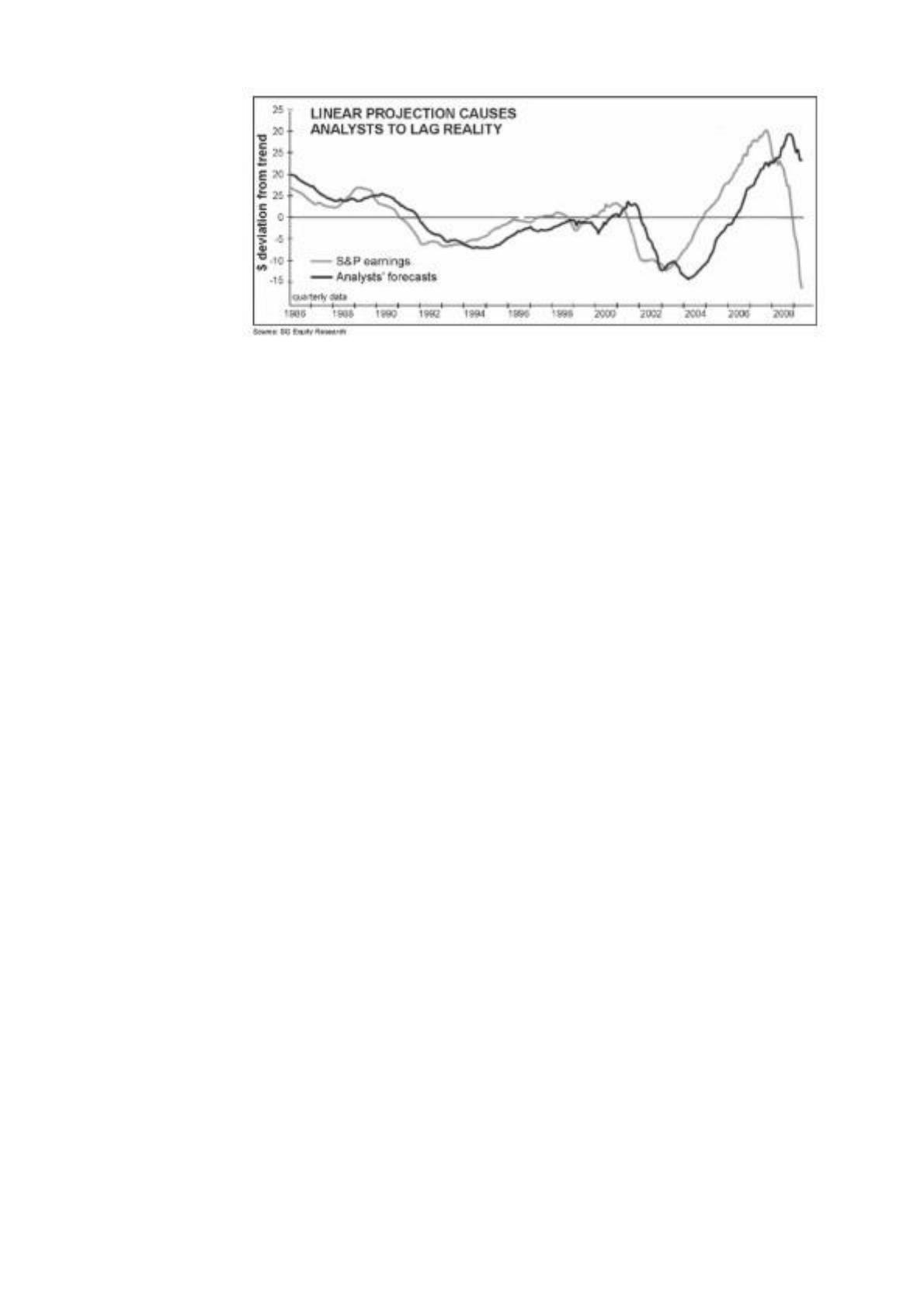
trend in effect will continue. Figure 1 displays the history of actual earnings of S&P
companies vs. analysts’ predictions of those companies’ earnings. It shows that
analysts’ forecasts have lagged actual earnings by about a year. The extreme lag is
due to their prediction model, which involves the linear extrapolation of delayed data.
James Montier, who published this chart, commented, “The chart makes it
transparently obvious that analysts lag reality. They only change their minds when
there is irrefutable proof they were wrong, and then they change their minds very
slowly.” In other words, there is no anticipation, just lagging linear extrapolation.
133
Figure 1
This approach is ubiquitous throughout the economics profession. Some
observers have recognized the essence of the game:
Rearview Mirror Is Where Economists See Future
by Caroline Baum—Bloomberg, Sep 15, 2010
Every month, 60 respondents (on average) in the Bloomberg News economic
survey provide forecasts for various indicators, including real gross domestic product,
the consumer price index and the unemployment rate, and interest rates, such as the
federal funds rate and 10-year Treasury note yield, for the next few quarters and two
years out.
As U.S. economic indicators started to sputter over the summer, economists
duly marked down their forecast for third-quarter real GDP growth to 1.9 percent in
the September survey from 2.5 percent in August, 2.8 percent in July and 3 percent in
June. “Hindcast” would be a more apt description for what these folks do.
“It’s really an indictment of the forecasting business,” says Bob Barbera, chief
economist at Mt. Lucas Management Co., a New York hedge fund, and himself a
forecaster. That doesn’t mean extrapolating from one quarter to the next is a bad
strategy. “Allowing the pace of economic growth in the last three to six months to
dictate the next three to six months beats most forecasts—except when it matters,”
Barbera says.
And when does it matter? It matters at the turns. When you’re a linear
forecaster, you can’t detect any turns.